


Our integrated Supply Chain comprises the Manufacturing, Logistics and Retail operations that support our Brands pillar in SA and selected African countries. Our Supply Chain’s primary function is to give our franchise partners a competitive edge through effective supply, product innovation, and margin management. Our Supply Chain businesses are managed and measured independently.
Most of our manufacturing plants are wholly owned, but we also operate certain partially owned plants. The Retail business sells condiments (sauces, dressings, spices), frozen meat products, coffee (ground and beans), frozen chips and other value-added products.
Manufacturing
Trading conditions
In 2023, South Africa experienced significant food inflation due to local and international pressures. The ongoing Russia/Ukraine war drives inflation, with the largest impact on major commodities such as wheat and oils. In addition, the rising prices of agricultural inputs, including animal feed, fertilisers and insecticides, have increased food production costs for farmers. Other inflationary pressures in 2023 included:
- Elevated fuel prices and increased reliance on diesel to power generators.
- A weaker Rand/Dollar exchange rate increased the price of raw imported materials.
- Higher container freight costs increase the price of all imported raw materials.
- Significant price increases for tomato paste, MSG, food-grade acetic acids, milk and green coffee beans.
- Increased costs for all packaging substrates, including plastics, paper, cardboard and tin.
- Shortages of certain food items, for example, chicken, driving up pricing.
- An outbreak of foot and mouth disease in South Africa resulted in a ban on live hoofed animals, which resulted in a beef shortage and high prices from August to December 2022.
In South Africa, load shedding had a detrimental impact on procurement, where suppliers have not adequately invested in their own generation or other forms of mitigation. The biggest impact was on chicken production, where producers cannot produce chicken to our size specifications. We have mitigated this by sharing our orders among several major producers and increasing our supply base.
Performance and focus areas
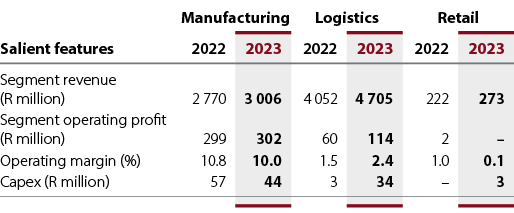
Manufacturing turnover was up 8.5% to R3 billion (2022: R2.8 billion), driven by strong volumes and inflationary price increases. This is up 8.4% on pre-pandemic levels (2020: R2.8 billion). Operating profit increased 1% to R302 million (2022: R299 million). The slight improvement in operating profit can be attributed to sharp increases in raw materials and a higher incidence of load shedding. Other impacts include a 26% increase in expenses at Cater Chain and lower volumes produced by the Famous Brands Cheese Company.
Despite the significant inflationary pressures, our internal cost inflation increased by 1% to 6%. This is still below the consumer price index inflation of 13.6% in February 2023. We often did not pass on the full increases to the front end to drive increased restaurant sales with competitive pricing.
Most plants performed well, with production volumes up, depending on the product line. Several plants have improved their yield by refining their production processes and reducing waste. This is part of our continued Manufacturing Way process efficiency drive.
Overall, inventory control management has been well-controlled. Manufacturing increased its inventory holdings of key products due to shortages and unreliable supply. This includes increasing our holdings of white and brown sugar and beef.
Products with higher Quick Service Restaurant exposure continue to perform better than those with high Casual Dining Restaurant exposure, although the latter did recover in 2023. Demand from Retail sales continued to grow. The Famous Brands Cheese Company was impacted by lost volumes due to poor product quality in early 2023, which resulted in Famous Brands temporarily procuring cheese from an alternative supplier. Demand from Retail sales remained steady; however, volumes at our sauce plant were down due to lower Retail volumes in certain sauces.
Load shedding continues to increase costs and disrupt production at all plants, but the impact was particularly felt at Lamberts Bay Food and the meat plant. A new generator was commissioned at the meat plant in July 2022. At Lamberts Bay Foods, a rental generator was installed to run the plant from September 2022 until February 2023. A new generator was commissioned at the end of February 2023 to allow the plant to run optimally throughout load shedding. At Cater Chain, we have ordered a larger generator to run the production and refrigeration, with commissioning planned for June 2023.
Investing in solar installations remains a priority. The 242kWp solar plant commissioned in February 2022 at the meat plant has generated 329 215kWh of electricity and saved R608 936 in municipal electricity charges in 2023. This installation offsets approximately 20% of the generator load.
Lamberts Bay Foods and the meat plant continue to be affected by regular water outages. Lamberts Bay Foods is implementing a water recovery project to reduce water consumption by 25%, or approximately 100 kilolitres per day.
In addition, Manufacturing focused on the following key initiatives for 2023:
- Developing new products and refining existing products.
- Improving gross profit margins on products wherever possible.
- Rolling out person-machine-interfaces to more plants.
- Maintaining the National Occupational Safety Association of South Africa (NOSA) ratings.
- Implementing Sage X3 at the Meat Plant to improve financial management and have all financial information on one system.
- Concluding a two-year wage agreement at Lamberts Bay Foods.
The Famous Brands Coffee Company continued to benefit from the relocation to a more efficient site in 2022. The repurpose assessment was not viable which led to a new site being chosen.
The meat plant successfully commissioned a new piece of equipment in the Halaal production area. This allows the patties to freeze quickly, improving the overall product quality. In 2023, Famous Brands brought the manufacture of all streaky bacon back in-house, equivalent to annualised volumes of 201 tonnes. This forms part of our long-term plans to change how we produce bacon to manage pork costs.
The sauce plant improved factory efficiency, resulting in reduced shifts, less overtime and lower cost of causal labour. In addition, the person-machine-interface technology was commissioned at the plant, allowing for live tracking of production outputs for Retail and bulk lines. Management can access live information, which allows for faster course correction.
The first phase of new cleaning in place (CIP) equipment was commissioned at the sauce plant. CIP is an automatically performed method of cleaning, applied to remove residues from complete items of plant equipment and pipeline circuits without dismantling or opening the equipment. The newer equipment is more efficient, allowing for multiple CIPs on pots, holding tanks and production lines. This was not possible previously, as only one CIP could run at a time. Due to increased capacity, we were able to bring back additional volumes that were previously outsourced.
In 2023, Famous Brands was audited by the NOSA, with no plant receiving a rating below three stars. Five of our plants received a four-star rating, including the Famous Brands Cheese Company, TruBev, Meat Plant and Turn ‘n Tender Central Kitchen (2022: Five). In 2024, we seek to improve our NOSA ratings performance.
We emphasise a leader-led safety culture in Manufacturing. Food safety risk was managed well; no plant stoppages occurred in 2023. We received 100% food safety accreditation across all manufacturing plants.
Capex decreased to R44 million (2022: R57 million), including investments in new, more efficient generators and electrical works to install generators. We allocate sufficient maintenance capex to ensure that our assets are well-maintained.
The Group monitors consumer complaints across all plants, and the number of complaints has declined despite substantially higher volumes.
Implementing our ESG roadmap
In 2023, we began implementing the first phase of our ESG roadmap for manufacturing. The five-year ESG targets were set and the business is on track to achieve these objectives. The plan for 2024 is to conclude the formulation of a Sustainability Framework and an Environmental Programme.
Focus for 2024
Some food shortages are likely to persist, and food security remains a major global risk. We will continue to list alternative suppliers, including Black-empowered suppliers, to mitigate the risk for key commodities. We expect to invest working capital into securing additional inventory to lock in pricing and supply.
The Manufacturing division will focus on the following in 2024:
- Improving operational efficiencies and lowering costs to improve overall profitability and offer more competitive products to our franchise partners.
- Implementing the second phase of our ESG roadmap.
- Rolling out person-machine-interfaces to more plants.
- Replacing older generators with more efficient and reliable ones.
- Relocating to a new sauce plant warehouse in April to allow for better production flows and efficiencies. This will also create more space to hold Retail inventory on-site.
- Implementing the second phase of CIP at the sauce plant to reduce chemical usage and water consumption.
- Maintaining and improving NOSA ratings.
- Implementing capex to improve yield and efficiencies at the Famous Brands Cheese Company.
Logistics
Performance and focus areas
Logistics revenue increased 16% to R4.7 billion (2022: R4 billion), driven by increased volumes and prices, while operating profit increased 89% to R114 million (2022: R60 million). In 2023, we received a R10.8 million insurance recovery related to the civil unrest in July 2021. The operating margin increased to 2.4% (2022: 1.5%).
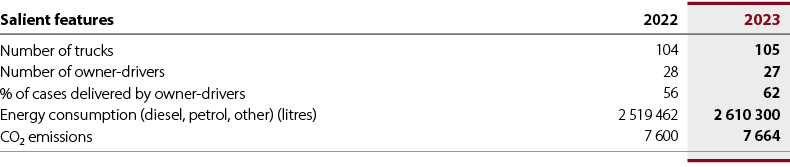
Case volumes grew 6.2% year-on-year and compares favourably with pre-pandemic levels. By the end of 2023, rising interest rates, high unemployment and shrinking consumer spending dampened volumes. The division was affected by increasing fuel and commodity prices and load shedding. Logistics increased its inventory holdings of some commodities cover to reduce the risk of price volatility and product shortages.
In November 2022, Famous Brands completed the successful relocation of the KwaZulu-Natal Distribution Centre. The new distribution centre offers the following advantages:
- Larger space to cater for the increase in volumes.
- Modern and efficient refrigerated storage capacity.
- Better geographical location and access to the road network.
In February 2023, we installed 612 solar panels and six inverters at the new KwaZulu-Natal Distribution Centre. They are expected to generate more than 390 000kWh per year. The payback period for this investment is five years.
The KwaZulu-Natal Distribution Centre went live with a new warehouse management system in October 2022. We currently have five distribution centres using this system, which offers productivity and efficiency advantages. We will complete implementing this system at the Eastern Cape Distribution Centre and the Free State Distribution Centre, the only outstanding centres, in 2024.
We extended the current lease of the Crown Mines Distribution Centre to May 2025 while we complete the relocation project to the Midrand Campus. We have purchased the current Head Office and two adjacent properties in Midrand and will proceed to consolidate manufacturing and distribution facilities on the Midrand Campus.
We implemented the first phase of the new layout at the Eastern Cape Province Distribution Centre, adding new shelving and racks while increasing the flow and efficiency of certain areas. We expect to complete phase two of this project in 2024.
At the Western Cape Province Distribution Centre, we implemented a water-saving project that reuses the condensed water runoff from the freezers. This project will save 2400 kilolitres per year.
All distribution centres once again achieved a four-star NOSA rating for safety.
Capital expenditure of R33.6 million (2022: R3 million) was incurred, largely attributed to completing the KwaZulu-Natal Distribution Centre relocation project.
Focus for 2024
- Complete the implementation of a new warehouse management system across all distribution centres.
- Continued benchmarking of processes, costs and margins to ensure efficiencies and reduce operating costs.
- Improving fire protection and smoke detection systems at the Western Cape Province Distribution Centre, Gauteng Distribution Centre and the Free State Distribution Centre to meet insurers’ requirements.
Retail
Performance and focus areas
The Retail division grew revenue by 23% to R273 million (2022: R222 million). While operating profit declined 91% to R150 000 (2022: R1.6 million), with coffee product write-offs impacted profitability. A shortage of coffee crops in South and Central America has increased the pricing of all single-origin coffee, with large price increases negatively affecting supermarket sales. The house brands underperformed in the coffee category, while the Mugg & Bean range sold well.
The sauces range did not perform well in 2023 due to poor volumes purchased by large independent buying groups and reduced product ranges, including sauces, in several Pick n Pay stores due to their new store format strategy.
The retail trading environment remains price-sensitive and consumers increasingly seek good value. Our well-known brands and attractive price points have allowed Retail to expand its retail footprint and sales. Our trusted brands and value-for-money offerings have enabled Retail to grow volumes and footprint.
In 2023, the Retail division launched 13 new products (2022: 16), including two new types of chip variants; namely Wimpy chips, Wimpy Hashbrowns and two types of a newly launched brand call West Coast Potato Chips, plus new variants of sauces and meat products. The Wimpy offering has been particularly well-received by consumers. In the frozen meats category, the product launches of Steers rib burger patties and Wimpy pork bangers are showing promise.
Focus for 2024
The Retail division plans to expand the business by launching 12 new products, promoting existing products and growing its retail footprint.
New product innovation will focus on expanding existing categories.
Group associates
Famous Brands holds strategic stakes in the following entities: UAC Restaurants in Nigeria and Sauce Advertising, DHQ and FoodConnect in South Africa.
 |
 |
 |
 |
|
This business comprises the Mr Bigg’s and Debonairs Pizza brands in Nigeria, a central kitchen (bakery and manufacturing), and a distribution component. |
Sauce Advertising assists the Group by providing enhanced marketing capabilities and leveraging marketing spend to improve the business’s competence in the digital market. |
FoodConnect is a sales and distribution business in the food and beverage sector. It owns the Group’s Baltimore ice cream brand rights and distributes the product to third parties. This provides Famous Brands with a strategic route-to-market. A Level 2 B-BBEE contributor, FoodConnect supports the Group’s transformation agenda. |
DHQ Interior Brand Architects (DHQ) provides restaurant planning and design services to the Group and third-party clients. Famous Brands now holds 48.5% of DHQ (formerly 60%) after the DHQ employees’ share trust was created. Famous Brands donated the shares to the trust. |
|
Shareholding owned by the Group: 49% |
Shareholding owned by the Group: 37% |
Shareholding owned by the Group: 49% |
Shareholding owned by the Group: 48.5% |
