

Our Remuneration Policy aims to align the interests of senior executives and employees with the interests of shareholders and the Group’s overall business strategy.
The Remuneration Policy and the LTI in particular have gone through a substantive review in the past two years to adjust to today’s business and economic realities. This includes considering the impact of both GBK and COVID-19. This was completed to ensure that it remains relevant and achieves its intended objectives of retaining and rewarding our management.
However, we acknowledge that the Remuneration Policy is a living document and is subject to regular review and change. In 2023, we revised our Remuneration Policy, to improve clarity and completeness.
The Remuneration Committee’s mandate (refer page 135) is to assist the Board in discharging its oversight responsibilities relating to all compensation matters.
Our policy design
Our remuneration policy, setting out the Group’s remuneration principles and practices, applies to all employees. It provides a high-level guideline for implementing the Group’s remuneration strategies and designing and managing remuneration processes.
The policy was designed around the following themes:
- Support for the business strategy, objectives and long-term interests of Famous Brands and its stakeholders, aligned with the Group’s beliefs and values.
- Maintain a competitive reward system to attract, motivate and retain high-performing individuals, including industry-competitive packages.
- Apply consistent and responsible business and remuneration practices, sound and effective risk management and governance.
- Develop performance metrics that are demanding and sustainable and cover all relevant aspects of the business.
The policy also considers King IV (principle 14), the Companies Act 2008, the Basic Conditions of Employment Act 1997, the Employment Equity Act 1998 and other applicable legislation.
The use of remuneration consultants
The Committee can obtain advice from independent remuneration consultants, where appropriate. The Committee employs and engages with them directly to ensure independence. The Committee reviews the consultants’ independence annually.
The Committee typically engages consultants to perform the following services:
- Job evaluation and organisational design.
- Executive salary surveys.
- Annual benchmarking of STI scheme.
- Review of the LTI scheme.
- Advising on the remuneration report for the IAR.
Our approach to remuneration
Famous Brands’ remuneration objective is to attract, motivate and retain a skilled workforce through fair, responsible, transparent and competitive remuneration.
Key principles of this Remuneration Policy
The Remuneration Policy is in place to support our remuneration approach and is based on the following key principles:
- Reward, retain and, where necessary, attract talent through fair, transparent and competitive remuneration.
- Reward short-term and long-term performance by linking STIs to operational, financial and other targets; and LTIs to the achievement of Famous Brands’ strategic objectives.
- Key focus areas are reflected in the scorecard of executive management and the annual performance evaluations for employees. Scorecards reflect KPAs and the associated KPIs.
- We reward for value created contribution and performance to ensure alignment with shareholder interests, balancing this across economic, social and environmental aspects.
- Employee rewards are influenced by individual and Company performance, and employees’ contributions are recognised through a discretionary performance bonus.
- Bargaining unit employees are subject to the terms of wage agreements and are part of a “basic plus benefits” remuneration scheme
Fair and responsible remuneration
The remuneration principles are underpinned by a fair and responsible remuneration approach where:
- Remuneration must be free from any form of discrimination.
- Market benchmarking refers to the correct remuneration bands and levels with progression reflected for experience and accountability.
- Remuneration design and application must drive internal and external parity.
- All the applied remuneration components are designed and implemented within the applicable tax and regulatory requirements.
- Performance and value are defined and measured over the short, medium and long terms and protect our shareholders’ interests.
- An overarching drive for the correct moral and legally defensible remuneration practices.
We focus on developing an equitable workplace. We commit to equal pay and gender equality in line with the JSE Listings Requirements and King IV.
Famous Brands conducts an equal pay for equal work audit as part of the annual salary increase exercise in March each year. The following interventions were applied this year in response to findings from the audit:
- Three discrepancies were identified in Manufacturing and the gaps identified were closed in line with the peer group.
- Seven discrepancies were identified in Logistics and gaps were closed in line with peer group.
- In the rest of the Group, 51 discrepancies were identified, and the salaries were adjusted accordingly.
Definition: equal pay
The principle of equal pay applies to work that is the same, substantially the same or of equal value (referred to as work of equal value) when compared to an appropriate actual comparator of the same employer.
This means where comparable work is of equal value, employees rendering such comparable work should not be paid unequal pay where differentiation between them is based on a prohibited ground of discrimination or on arbitrary grounds.
Benchmark methodology
Famous Brands undertakes a total remuneration benchmark at least every two years, using reputable remuneration consultants.
The one benchmark uses a database covering over 700 South African companies, extracting data from companies with a relevant job match. The second benchmark is from a specified comparator group of companies the Committee approves.
An overview of the remuneration components
The key components of remuneration at Famous Brands:

The remuneration structure for executives and employees in senior management positions comprises guaranteed (including benefits) and variable remuneration (together referred to as the pay mix). A different set of rules and guidelines are applicable to each remuneration component.
Pay mix
Famous Brands’ pay mix aims to achieve a balanced mix appropriate for the job, level and performance and in line with market practice. In 2023, Deloitte reviewed the pay mix and determined that the pay mix is appropriately aligned with the current market, and there is no need for adjustments at this time.
There is a balance between fixed and variable pay. For F-level positions (Executive committee, the CEO and his direct reports), fixed pay represents about 51% of total remuneration, which is deemed high enough to avoid employees becoming overly dependent on variable pay. This pay mix ratio is in line with the market remuneration mix.
Remuneration landscape and eligibility
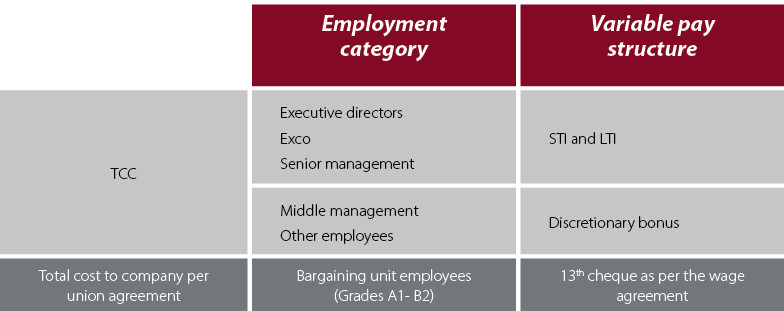
Cost to company and bonus
Base salary
Salaries are reviewed annually in May after the audited financial results are available. The increase is effective 1 March of each year. Increases are informed by consumer price inflation (CPI) and adjusted upward or downward to recognise individual performance. Bargaining unit employee increases are based on two-year wage agreements.
The CEO makes recommendations regarding Exco’s increases to the Committee. The Committee reviews the CEO’s base salary.
The overall increase pool is expressed as and limited to a percentage agreed by the Committee.
Performance measures for executives
Individual performance is reviewed on a scale of 1 to 5, where 1 does not meet expectations and 5 exceeds expectations. The performance rating determines the percentage of the CPI increase pool that an executive will receive. Performance is measured against specific KPIs approved by the Committee.
Retirement fund
All Company-related funds are defined contribution funds. Retirement funds vary depending on jurisdiction and legislation. Famous Brands ensures contributions align with country-specific legislation and any Company contribution is part of TCC.
Medical insurance
Medical funds vary depending on jurisdiction and legislation (some countries have national insurance). Any Company contribution towards a medical aid fund form part of the total guaranteed package, in line with Company policy.
Benefits
Benefits are provided based on local market trends and ensure overall competitiveness in the respective markets. Benefits can include life insurance, dread disease insurance, temporary and permanent disability, accidental death insurance, assistance with tax filing, cash in lieu of leave not taken (above legislated minimum leave requirements) and provisions under the executive travel guidelines.
Allowances
Allowances are linked to specific tasks, for example, a subsistence allowance for specific types of travel. Separate policies cover these types of allowances, or it is covered in the bargaining unit’s recognition agreements. No discretion is applied.
13th cheque
The 13th cheque is part of guaranteed pay for bargaining unit employees and forms part of the wage agreement with the trade unions.
Discretionary bonus
A bonus is provided based on individual performance, subject to Company performance criteria. It can only be up to 120% of one month’s TCC, and a sliding scale adjustment is made to recognise individual performance.
Performance ratings of less than 3 do not qualify for the discretionary bonus. This applies to all the employees outside the bargaining unit parameters but below the executives.
Short-term incentives
The STI is designed to drive the short-term strategies of Famous Brands (aligned to annual business plans and budgets) and ensures that participants deliver on the key priorities for the year. Performance ratings of less than 3 do not qualify for the STI. These have been designed to align and deliver on the Company and shareholder interests. The STI incentivises and drives participants’ motivation, contributes to attracting and retaining scarce human resources, and rewards superior performance.
The STI is paid in total in June each year.
How it is calculated
In 2023, Deloitte reviewed the STI scheme and recommended that the scheme rules were simplified and redesigned to remove the correlation between the weighted performance score and the amount of target STI earned. The scheme was redesigned so that the weighted performance score between 100% and 116% determines the target STI payout between 100% and 200%. A threshold payment of 50% of the target was introduced for performance sufficiently above the business plan. The redesigned scheme still incorporates leverage, with a maximum payout of 200% of the target.
The target STI is a targeted amount (a percentage of TCC) applicable to a person’s Paterson grade. The actual STI earned depends on performance.
Target STI is determined by market benchmarked targets and is validated regularly. The performance score is determined by individual and Group/operational performance relevant to the individual’s role to create a line of sight between business performance and individual reward. These are weighted and collectively provide a weighted score for the individual. Before the start of each half-year, the Board approves KPAs and associated KPIs.
In this design, the following formula will apply:
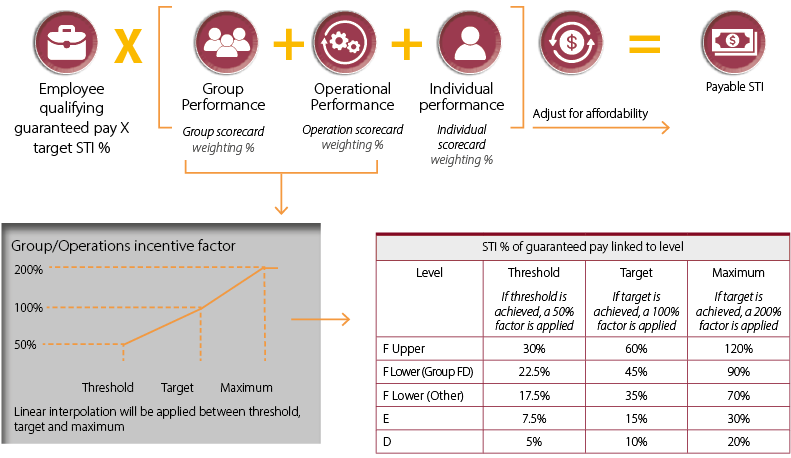
To drive line of sight principles, STI earnings are linked to areas where the executive has accountability and the ability to influence. The percentages reflect the relative weighting of performance on the ultimate combined scorecard of the participant.
Relative weighting of performance (%)
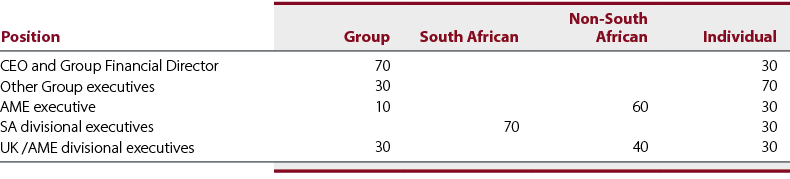
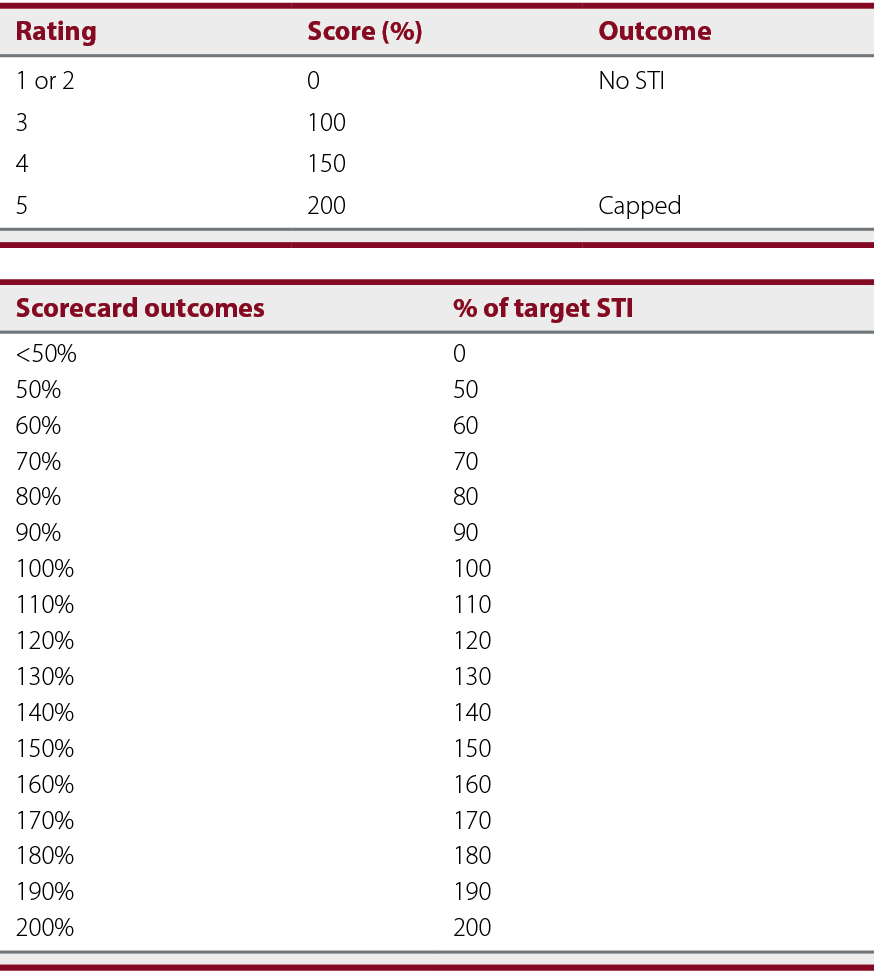
Individual performance is reviewed on a scale of 1 to 5. Performance ratings of less than 3 disqualify a participant from the STI scheme.
The combined outcome of the individual performance, and performance against the KPAs and KPIs, result in the actual percentage of target STI earned (which has a maximum cap).
The table alongside indicates how line of sight is achieved between combined performance and the individual’s level of STI earned, supporting the principle of rewarding exceptional performance.
The 2023 Group scorecard is:
| Key performance areas | KPIs and targets |
| Financial performance and operational plan performance (60%) |

|
| Market-share performance and consumer measures (20%) |
|
| People performance (10%) |
|
| Transformation and ESG (10%) |
|
Long-term incentives
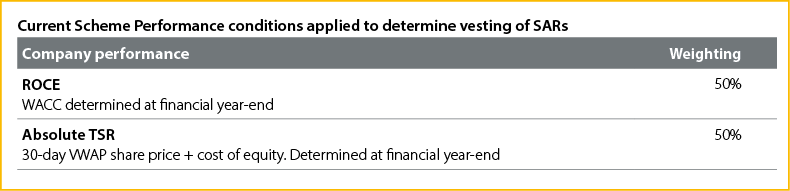
The LTI is designed to drive the longer-term strategic and sustainable focus of Famous Brands, ensuring alignment between the long-term interests of executives and shareholders. It serves as a wealth creation mechanism for executives and drives the creation of shareholder value when strategic performance drivers are met. In 2024, the Long-Term Share Plan will replace the existing LTI. The current granted awards will continue to vest as per the rules of the current scheme.
Current Scheme Vesting structure and methodology

 |
The vesting structure in terms of the new share plan has been simplified. All share awards vest in year three, provided that the service condition and performance conditions which were set at award date are met (read more). Share appreciation rights no longer exist in the new Share Plan. |
New Share Plan award methodology
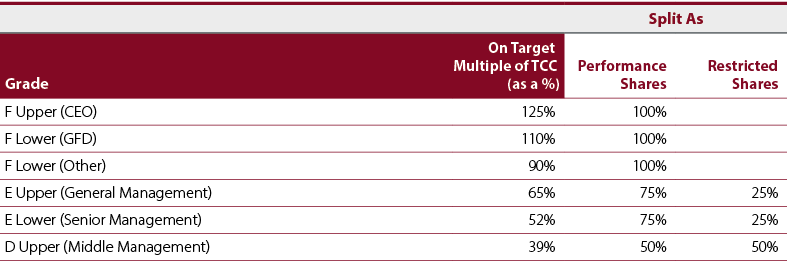
HEPS was reintroduced in the new Share Plan (defined as growth in HEPS vs CPI). Targets CPI + 5% and a stretch target of CPI + 10%. (read more)
New Share Plan Performance Metrics and Conditions
| FY23 Long-term Incentive Performance Metrics and Conditions | |||||
| KPIs and weightings | Further detail | Threshold 50% Vesting | Target 100% Vesting | Stretch 150% Vesting | |
| Profit (45%) | HEPS Growth | Three-year HEPS CAGR | CPI + 2% | CPI + 5% | CPI + 10% |
| Shareholder Value (45%) | Total Shareholder Return | A relative measure of TSR against a bespoke comparator group. | 50th percentile | 60th percentile | 80th percentile |
| A relative measure of TSR against Cost of Equity. | COE | COE + 2% | COE + 5% | ||
| ROCE | Three-year return relative to the business plan. | 150% of WACC | 170% of WACC | 200% of WACC | |
| Doing Business the Right Way (10%) | Environmental, Social and Governance (ESG) Meet sustainability targets set for 5-year plan |
GHG for RSA business. | Tons CO2e emitted (direct and indirect), excl generator power >90% of target | Tons CO2e emitted (direct and indirect), excl generator power = 100% of target | Tons CO2e emitted (direct and indirect), excl generator power >110% of target |
| Water for RSA business. | Kilolitre of water (direct) >90% of target | Kilolitre of water (direct) = 100% of target | Kilolitre of water (direct) >110% of target | ||
| B-BBEE/Transformation. | B-BBEE score >80 | B-BBEE score >85.13 | B-BBEE score >87 | ||
Malus and clawback
Famous Brands has malus and clawback provisions that enable adjustments to variable pay.
The Board may act on the recommendation of the Committee to reduce/cancel/adjust unvested variable remuneration (malus) or to recover (clawback) vested/paid variable remuneration where there is reasonable evidence that an executive director of Famous Brands materially contributed to, or was materially responsible for, but not limited to:
- Personally acting fraudulently or dishonestly or in a manner that adversely affects the Company’s reputation or is characterised as gross misconduct.
- Directing an employee, contractor or adviser to act fraudulently, dishonestly, or to undertake other misconduct.
- Receiving an STI or LTI award because of fraud, dishonesty or a breach of obligation committed by another person.
- Receiving an STI or LTI award because of an intentional error in calculating a performance measure.
Recruitment, contracts and termination
Recruitment
When recruiting new executives, a comparative benchmarking exercise is done to determine the size, nature and complexity of the role and the skills availability before making a competitive offer.
For new appointments, the Committee may consider compensation for remuneration forfeited by the appointee (STI, LTI, or any other relevant and valid element). The intention is to not grant more than what the appointee would have received from the Company in a 12-month period.
The Committee does have the discretion to compensate higher values if it can be demonstrated through a fair-value valuation that the forfeited amounts exceed the grants. The Committee compensates the forfeitures through a combination of equity and cash.
Famous Brands has a formal Recruitment and Selection Policy.
Sign-on
Sign-on bonuses are paid at the discretion of executive management and the Committee.
Service contracts
All executive team members have permanent employment contracts that entitle them to standard Group benefits as defined by their specific region and participation in the Company’s STI and LTI.
In exceptional situations, an executive team member can be appointed on a fixed-term contract.
Employee contracts contain defined termination notice periods, and the executive management team has a three-month notice period.
Termination
The executive management team typically does not have fixed-term contracts, and contracts are, therefore, open-ended. Exceptions include where prescribed retirement ages apply or where specific circumstances justify the appointment on a fixed-term basis.
The incentive scheme rules are clear on the termination provisions by termination category. In the event of termination, the Company can allow the employee to either work out their notice period or pay the TCC for the stipulated notice period in lieu of notice.
Employment contracts do not oblige Famous Brands to pay special severance or compensation on termination of employment contracts arising from failure or incapacity to perform or underperformance against contracted objectives.
| Voluntary resignation | Dismissal/termination for cause | Normal and early retirement, retrenchment and death | Mutual separation |
| Base salary | |||
| Paid over the notice period or as a lump sum. | Paid up to the date of dismissal (exit date). | Paid up to the date of retirement or death or for a defined period based on policy and legislation governing retrenchment conditions. Death benefits are paid to the spouse (if relevant). | Paid over the notice period or as a lump sum or per agreement to remain on the payroll until agreed date. | Retirement fund |
| Provident fund contributions for the notice period will be paid. The lump sum does not include provident fund contributions unless contractually agreed. | Contributions to the provident fund will be paid until employment ceases. | Provident fund contributions for the notice period will be paid. | |
| Medical provisions | |||
| Where applicable, medical provision for the notice period will be paid. | Medical provision/payment will be provided until employment ceases. | Medical provision/payment will be provided until employment ceases. Subject to the medical aid rules, the employee can become a direct paying medical aid member. | Medical provision for the notice period will be paid; the lump sum can include medical fund employee contributions if contractually agreed. |
| Benefits | |||
| Applicable benefits may continue to be provided during the notice period but will not be paid on a lump-sum basis. | Benefits will fall away when employment ceases. | Applicable benefits may continue to be provided during the notice period. | |
| STI | |||
| No STI | No bonus, but Committee has the discretion to award pro-rata STI. | ||
| Sign-on or retention deferred bonuses | |||
| Lapse all deferred bonuses. | Pro-rata deferred bonuses based on the length of employment from the date of allocation. | The Committee determines whether a pro-rata portion may be granted. A work-back clause may not apply. | |
| Sign-on bonus work-back clause will apply – i.e. if not worked back in full, pro-rata repayment. | |||
| LTI | |||
| Unvested shares will lapse in their entirety. | Lapse of all unexercised and unvested shares; vested shares will be unaffected. | Pro-rata unvested LTIs are based on the length of employment from the date of the offer. Performance conditions are tested over the full performance period and vest on the normal vesting dates. (In case of death, test performance as per the latest results applies immediate vesting). | The Committee determines whether a pro-rata portion may be granted (or the Board in the case of the executive directors). Performance conditions are tested over the full performance period and vest on the normal vesting dates. |
Minimum shareholding requirements
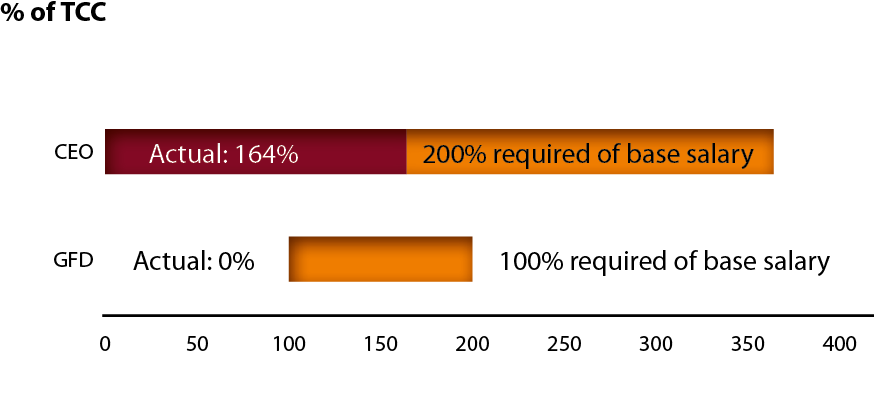
Executive directors are required to build and maintain a minimum holding of Famous Brands shares. They may sell only up to 50% of their shares that vest until they have reached their minimum shareholding requirement. The CEO must hold 200% of their base salary, and the Group Financial Director must hold 100% of their base salary.
Non-executive directors fees
Non-executive directors have formal letters of appointment and are paid based on their role. The policy is applied using the following principles:
- A Board fee is paid for the five Board meetings held each year, and the Committee members receive Committee fees for participation. The fees are split with a base fee of 20% and the remaining 80% paid based on meeting attendance. Each director’s fee is paid quarterly in arrears.
- The Committee has recommended that directors’ fees be amended to a flat fee and not a split fee. This will be proposed to shareholders at the AGM in July 2023.
- Fees are reviewed annually, and increases are implemented from June after approval by shareholders at the AGM.
- The level of fees is set using a comparable benchmark group derived from companies with similar size, complexity and geographic spread.
- The non-executive directors are not eligible to receive any short or long-term incentives.
