

It is the view of the Remuneration Committee that the Remuneration Policy has achieved its stated objective of driving performance while ensuring retention.
We value the opportunity to engage with shareholders to better align their interests and perspectives with those of our executives for the long-term benefit of the Group. Our stakeholders’ views were a major consideration in our decision making for 2023, including a complete review of our LTI scheme.
External considerations |
|
Internal considerations |
|
Shareholders’ view on our remuneration
At the 2022 AGM, both our remuneration-related resolutions did not receive the requisite 75% shareholder support. The issue of the 2022 grant letters to approved participants was suspended, pending the outcome of the engagement with shareholders.
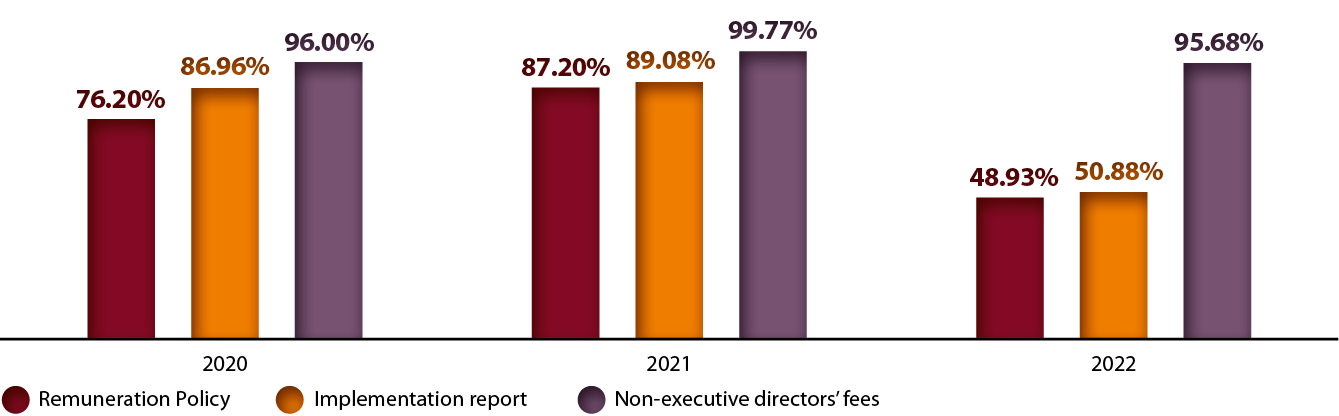
The Committee engaged extensively with various shareholders regarding the underlying reasons for dissenting votes. Our response to shareholders is detailed in the following table.
| Shareholder feedback | Committee feedback and actions taken |
| LTI performance metrics not sufficiently challenging | |
| ROCE: The stretch target of 130% of WACC is not sufficiently challenging compared to historic ROCEs. |
We believe that 130% of WACC is sufficiently challenging given the difficulties that the business has overcome and the trajectory going forward. While Leading Brands has recovered, there are other areas where this is not the case. Signature Brands’ have not recovered to pre-pandemic levels. Margins will remain under pressure for some time. We have aligned the new targets based on the new incentive plan to a 200% of WACC as a stretch target. |
|
Concern about how the GBK impairment will be treated. If no adjustment is made for the impairment (adding the impairment back to the capital base), then ROCEs will be artificially overstated. |
ROCE is calculated on continuing operations, which excludes the impact of GBK. |
|
Absolute TSR: The target of 30-day VWAP + cost of equity is too low. The 30-day VWAP as at 22 February 2022 was below pre-pandemic levels. |
These concerns have been taken into account and TSR targets will be measured as follows:
|
|
Concerns around the choice of metrics.
|
The instability in the business in recent years, including COVID-19 trading restrictions, KwaZulu-Natal floods and the riots of July 2021, has meant that the HEPS targets, which have been set historically, have not been met. The Committee, therefore, did not have the confidence to establish medium to long-term HEPS performance and HEPS was removed as a measurement for 2022. The Committee and the Board considered reintroducing HEPS or another income statement measure in the LTI targets, based on long-term budgets. For 2024, HEPS was reintroduced as a metric. The concern around absolute TSR was considered, however, certain shareholders have indicated that they believe that TSR should be retained and TSR was not removed as a metric for 2024. Refer to measurement above. |
|
Greater detail on how the LTI works in practice, such as the retention share relative to the share appreciation rights and the top-up grants relative to the new grants. |
The Board will consider conducting detailed investor sessions to unpack, among others, the LTI and what informs it. Share appreciation rights will no longer be applied following the adoption of the new Long-Term Incentive Share Plan. |
| Disclosure of targets, reporting process and timelines | |
|
While we endeavour to engage proactively, we are deliberate in terms of what information is provided. The Board is obligated to ensure that it treats all shareholders equally. This means that if the Remuneration Policy or its metrics are shared proactively with one shareholder, it will need to be published to all. If certain forward looking information is provided, it runs the risk of being seen as guidance, which is prohibited by the JSE Listings Requirements. In 2023, we published our results 7 working days earlier than in 2022. |
| ESG targets | |
|
In terms of ESG and sustainability, we are satisfied with the progress being made in evolving meaningful measurements to account for the Group’s commitments in our sustainability focus areas. The ESG targets against which management is measured are set out on page 148 and are included in the Group performance scorecard, which will be used to measure management performance. These measures include:
|
| Fees to non-executive directors | |
|
The Remuneration Committee considered the proposal to pay a fixed fee to directors and agreed to adopt a fixed fee for 2024, subject to shareholder approval. The details of fees paid to non-executive directors are included in the remuneration report. |
Should 25% or more of the shareholders vote against either the Remuneration Policy or the implementation report at the next AGM, the Committee will seek to better understand dissenting shareholders’ concerns. A SENS announcement will be issued with the results of the AGM and proposed way forward for shareholder engagement, including the manner, date and timing of the engagement.
Key decisions and changes to policy
| Focus area | Consequent decisions by Committee | Reference |
|
Appropriateness of 75%/25% split in performance and retention shares |
|
Read more |
| STI key performance | KPAs are as follows:
|
Read more |
|
2024 Long-Term Share plan KPIs and targets |
|
Read more |
| Malus and Clawback Policy |
No malus and clawback conditions were triggered. The Malus and Clawback Policy was reviewed and found to be fit for purpose. |
Read more |
| Administration and bargaining unit employee increases |
|
|
| Administration employees bonuses |
|
Read more |
| CEO and Group Financial Director increases |
|
Read more |
| Executive salary increases |
|
|
| Non-executive directors’ fees |
|
Read more |
| 2018 and 2019 LTI vesting |
|
Read more |
Remuneration consultants
Where appropriate, the Committee obtains advice from independent remuneration consultants. The Committee employs the consultants directly, with direct engagement from the Committee to ensure independence.
In 2023, the Committee engaged the services of two remuneration consultancies, namely 21st Century Pay Solutions and Deloitte. The consultancy 21st Century Pay Solutions was contracted to conduct an annual benchmarking study on the STI scheme. The study considered the STI on target and maximum pay against the market and concluded that the STI was in line with the market.
Deloitte was consulted to perform the following services:
- Review the current LTI scheme including benchmarking the scheme against remuneration arrangements from the broader South African market. The benchmarking exercise also analysed the on-target pay mix from a best practice perspective. The findings suggest that the Famous Brands CEO and executives are well-positioned from a guaranteed pay perspective but fall slightly below market benchmarks from a cash target pay and total on target pay perspective.
- Design and recommend a revised LTI scheme, in the form of a Long-Term Share Plan, that is fit for purpose and ensures the attraction and retention of key senior management employees through market-aligned incentivisation.
- Review the STI scheme, considering current practices, targets, and pay mix and propose a new STI scheme (read more).
The Committee is satisfied with the independence and objectivity of both 21st Century Pay Solutions and Deloitte as being independent consulting firms with extensive experience in remuneration.
